Technology · 6 min read · By SpeedSite ·
The Cost of Building Software Is Heading Towards Zero. The Cost of Owning It Isn’t.
AI can now turn an idea into working software in hours. But generating the code is only the beginning. The lasting cost is keeping that software secure, useful and working as everything around it changes.
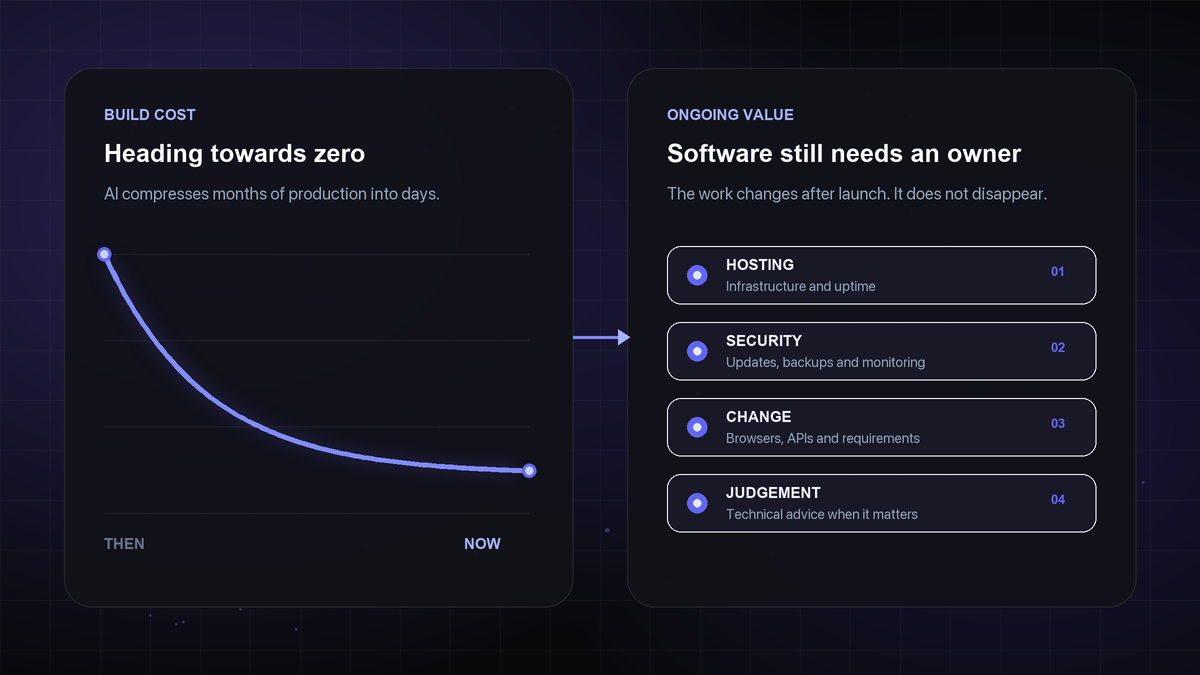
Software used to be expensive mainly because writing it took a lot of skilled human time. A new product could require a team of developers, months of work and a large upfront budget before a customer ever used it.
AI is changing that calculation. Today, a capable person can describe what they need and produce a website, internal tool or early product far faster than was possible even a few years ago. As the tools improve, the cost of turning an idea into code will keep falling.
It is tempting to conclude that software itself is becoming free. That is where the argument goes wrong.
AI is reducing the cost of creating software.
It is not removing the cost of running, maintaining and making good decisions about it.
Code is only one part of a working product
A piece of generated code sitting on a laptop has almost no business value. It becomes useful when real people can access it, trust it and rely on it.
That requires infrastructure: hosting, domains, databases, file storage, email delivery, payment processing, monitoring and backups. Some of those services charge a fixed monthly fee. Others charge according to usage. None disappears because AI wrote the application.
The first version also needs to work outside the ideal conditions of a demo. It must cope with slow connections, unusual devices, incorrect input and unexpected demand. It needs a sensible way to recover when something fails.
The world around your software never stops changing
Software does not remain finished. Browsers update. Search engines change their guidance. Payment providers release new APIs. Regulations create new obligations. Security weaknesses are discovered in previously trusted tools.
Even when your business requirements stay exactly the same, the technical environment keeps moving. A system that works perfectly today can become slow, insecure or incompatible if nobody looks after it.
There is also a steady flow of smaller business changes. A new service needs adding. A form needs another question. Prices change. Analytics reveals that customers are dropping out at a particular step. Each request may be small, but somebody still needs to understand the system and make the right change without breaking something else.
What continues to cost money
-
Infrastructure
Hosting, databases, domains, backups, email, storage and third-party services continue to have real operating costs.
-
Security and reliability
Updates must be assessed, data must be protected and failures must be detected before they become expensive problems.
-
Maintenance
Dependencies, APIs, browsers and devices change. Software needs adjustments to keep working properly.
-
Improvement
Customer feedback and business growth create new requirements. The product must evolve rather than slowly becoming less useful.
-
Technical judgement
AI can suggest many possible changes. An experienced person still needs to decide which ones are safe, necessary and worth paying for.
You may not need a technical team
For many small businesses, hiring a full-time developer or technical team no longer makes sense. The amount of routine coding has fallen, and most businesses do not have enough continuous technical work to justify the cost.
But having no technical support at all creates a different risk. When something breaks, the business starts from zero. When a supplier recommends a change, nobody can judge whether it is essential or unnecessary. When an AI tool produces an answer, nobody is accountable for checking whether that answer fits the business.
A better model is access to technical leadership when it is needed. Think of it as a fractional CTO: someone who understands your product, keeps an eye on the important technical changes and can step in to advise or make an update without joining your payroll full time.
The valuable part is moving from production to stewardship
When building software becomes cheap, manually producing every line of code stops being the main source of value. The valuable work becomes choosing the right solution, setting it up properly and taking responsibility for what happens after launch.
This is why a managed monthly service still makes sense in an AI-first world. You are not paying simply for the hours needed to type the original code. You are paying for the hosting, maintenance, security, backups, monitoring, support and technical decisions that keep the product useful.
At SpeedSite, those ongoing responsibilities are included in our packages. We use AI to remove unnecessary development cost and deliver quickly. Then we remain available to run the technical side, make relevant changes and give straightforward advice when the business needs it.
The bottom line
The cost of building the first version of software is heading towards zero. That is good news. It means more businesses can test ideas, automate repetitive work and create tools that would once have been too expensive.
But software still lives in the real world. It needs infrastructure. It needs maintenance. It needs to respond to technical and business change. Above all, it needs somebody who can tell the difference between a clever possibility and a sensible decision.
The future is not every small business employing a large technical team. It is every small business having affordable access to the right technical expertise, exactly when it is needed.
Need software without the full-time technical team?
SpeedSite builds, hosts and maintains websites and web applications with ongoing technical support included.
Tell us what you want to build